NOISY MINORITY ROLLERBLADE FILMS
Updated: May 22
Rollerblades, Punk Rock, VHS Tapes and Learning to Build Something From an Idea.

There are moments in life that only make sense decades later.
In 1994, I was working at the 5 star InterContinental Hotel Sydney and started rollerblading constantly. Every Wednesday night a group of up to 40 would skate through Sydney City from 7pm to 10pm, the mass stake was equal parts chaos, rebellion and freedom, which ended at The Paragon pub, all skating straight in the front door.
One night a cameraman named Richard Rowley came down to film us for Sky Channel. He was a cameraman for Better Homes and Gardens, who also freelanced shooting black-and-white sports snippets that were played between horse races, the this was the first the rollerblade footage in Australia.

About a 6 months later Richard called and saying he wanted to make a full-length rollerblade film. His goal was simple: he wanted a Director of Photography credit, and he asked if I wanted to be in the the film. I said no.
Not because I wasn’t interested, was skating constantly, but pain hurt and I wasn't the right person to film anymore. But the idea of the film was interesting and I started asking questions.
Who’s going to be in it?
Where are you filming?
What music are you using?
Who are the sponsors?
Who distributes it?

Eventually Richard stopped me and said, “Do you want to be Executive Producer?”
I immediately said "hell yeah", hung up. I called back five minutes later asking, “Sorry, what’s an Executive Producer?” The answer was simple, “Answer everything you just asked.”
I didn’t realise it at the time, but that “challenge accepted” instinct would become a recurring theme throughout my professional life.
Building Something from Scratch, Pre-internet.
The next 12 months became a full immersion into filmmaking, music licensing, production, logistics and relationship management.
I made one early decision that shaped everything. If we were making an Australian rollerblade film, then it needed Australian skaters, Australian locations and Australian music. At the time most surf, skate and ski films simply used whatever music they wanted and hoped nobody chased them for copyright later. That never sat right with me.
My thinking was simple, to bring this together correctly, every person, every element, must be credited and recognised. The skaters, the sponsors, the supporters and the musicians.
The problem was I had absolutely no idea how to access the music industry.
That changed one night at a farewell party for the editor of 3D World Magazine at Q Bar on Oxford Street. A lady simply asked me how I was, I replied, “Do you want the party answer or the truth?”
She laughed and said both. I told her the truth. I said I was lost and frustrated trying to find good Australian punk music for an Australian skate film. Smiling and handing me her card, she said “Well hi, I’m Jody Prior. I manage Monika from Monika and the Mooches. Call me Monday.”
That single conversation changed everything.


Within days of meeting her, I was introduced to Sydney’s independent punk, grunge, trash and ska music people. Soon I was spending nights in live music venues throughout Newtown, Enmore and the Inner West meeting bands, managers and label owners, explaining what we were trying to build.
Eventually we secured publishing rights, recording rights and copyright permissions for every song we used. To this day I think we may have been the first independent skate film company to properly clear all music legally.
It's a Sign
Around the same time the world decided to give me a sign, I was fired from the InterContinental for rollerblading to work, because it was considered “unbecoming of a five-star employee.” But i didn't recognise it, so i moved onto another hotel in Woolloomooloo, and its here the universe gave me the sign not even i could miss.
After finishing a morning shift I rollerbladed out of a staff door into the car park, down a ramp onto the street, to be immediately hit by a car. I landed on the bonnet, rolled up the windscreen, flipped over the roof and crashed on the street. The driver rolled down the window, leaned out and asked if I was okay. “Um, I think so” I said, she did a quick U-turn, pulled up next to me, and immediately sped off.
Sitting on the side of the street, a little banged up, i thought, fine, i get it, it's a sign. The next day quit hospitality and went all in on the film and the Rollerblading industry.
Cameras, Creativity and Controlled Chaos
We did everything everything ourselves.
Richard carried a massive Beta SP shoulder camera, the kind of full production television camera that looked like it weighed half a person. Alongside that we had a few Hi8 cameras. One of mine was literally taped to the end of a pool scoop pole so I could hold it above skaters for overhead tracking shots. Richard captured polished cinematic footage. I captured movement, chaos and energy. I’d rollerblade filming tracking shots, climb trees for strange camera angles, wedge myself into impossible corners or chase skaters through city streets trying to create momentum on screen.
It was an intense learning curve.
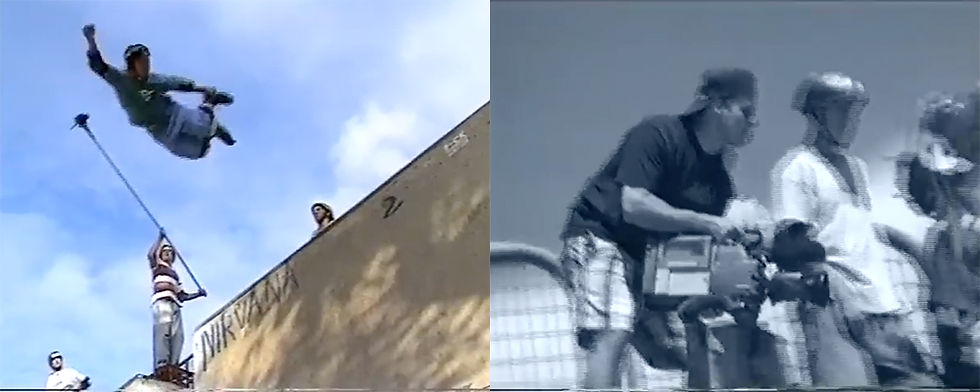
I knew still photography, but this was a completely different discipline. With photography you capture a single moment. With video you have to think about pacing, transitions, audio, continuity and editing points. A great trick might only last five seconds, but you still need to capture the moments around it.
We learned all of this by doing. There were no tutorials. No YouTube. No online courses. Just experimentation, mistakes and repetition.
Editing Until 2am
Every moment was filmed by us, every second edited by us.
Richard’s family worked in editing, which meant we could use their editing suite outside normal business hours. Those nights were long, we’d start around 7pm and work until 2am. Editing skating films was brutally time consuming.
Even the best trick in the world might only last ten seconds. To build a four-minute song section meant stitching together hundreds of tiny moments, often only a few seconds long. One three-minute section could easily take eight hours to edit properly. There were thousands of edit points across the films. Natural sound had to be added or removed. Music had to be aligned. Timing had to feel right. Every cut mattered. Neither of us were trained editors. We were simply learning by doing and trying to make each film better than the last.
Film 1: "Public Transport"
Somewhere during production the film found its name: Public Transport.
Honestly, the title probably came from me. At the time I didn’t drive, rollerblades genuinely were my public transport. If I needed to go somewhere, I skated there. Some days I was on skates for ten hours straight.

VHS and a Front Lawn Full of Dreams
One of my favourite memories was having an entire pallet of VHS tapes delivered to my front lawn simply because i wanted to physically see them.
Our local manufacturer offered direct freight to our distributor, but i wanted the tapes delivered to me first. I needed to them stacked there, to touch them, to make the whole thing feel real befor they disappeared into a warehouse ad store across Australia and around the world.
Punk Rock and Pool Tables
Our first film became the first Australian-made inline skating rollerblade video release. It wasn’t perfect, but it was real. Like anything creative involving talented people, there were opinions, egos and disagreements. Not everyone loved every section. But overall it worked.
Now i was determined to make the The second film stronger in every way. Better skating. Better filming. Better music. More confidence.
By then I was deeply immersed in Sydney’s punk scene, spending three or four nights a week in random pubs and venues watching bands, on stage filming CD launches. I spent all night networking and building relationships. My office was the pool table, the quieter part of a pub where we could play a game, drink and beer and chat. Luckily, i could play, well, so on more than one occasion I said "alright, if I win, I get to use the music."

I was in my twenties. Financially, there was almost no money in it. But creatively, it was exactly where I needed to be.
I worked in skating.
Filmed all week.
Edited all night.
Punk venues talking to musicians.
We eventually distributed the films into 12 countries around the world, and back then that meant physical VHS distribution.
No streaming! No digital downloads! No social media marketing!
Actual tapes! Actual boxes! Actual freight!
Film 2: Festival of Madness

This was the film where we hit our strides, the filming became tighter, the locations became better, but the most impressive part was the skating.
In 1996 Australia had 5 or 6 or the worlds best vert and street skaters, Extreme Games champions, Gravity Games Champions, Asian X Games champions, Wrap Tour Skaters, and Richard and I had the privilege of being their through their journeys and progressions from local skate park in best in the world.
This was the perfect next video for Noisy Minority films and by the time we wrapped i had already started planning the next one.
The Straight Jacket
The front cover for Festival of Madness became its own ridiculous story. I wanted a skater, on a handrail in a straight jacket to visually represent “madness.”
I eventually convinced a police museum in Parramatta to remove an actual straight jacket from display and let us borrow it for a photoshoot. When we collected it, it looked nothing like the classic straight jacket everyone imagines.
So the search continued.

Eventually I met a busker at Circular Quay who performed straight jacket escape acts. After enough convincing, and a case of beer, he agreed to lend us his jacket for a few days. As a result, I now know how to escape from a straight jacket in about fifteen seconds. A completely useless life skill. But somehow also a perfect summary of my twenties.
Film 3: "Road to Insanity"
The third and final film was to be called Road to Insanity. This was centred around a series of road trips, the big one, two weeks from Sydney to The Sunshine Coast in Queensland, and back again with a photographer and six skaters, filming everything along the way.
By then our cameras were better.
Our filming was better.
Our music access was better.
Our ideas were bigger.
Ironically, some of our best footage came from the one film that was never completed.
Sadly Richard developed chronic fatigue syndrome during production and the project came to a halt. Thousands of hours of footage were never fully assembled. At the time it felt devastating. Looking back now, it simply feels unfinished rather than failed.
Looking Back on it all Now
The remarkable part really isn’t really the skating, it isn’t whether the edits were perfect, it isn’t the commercial success, or even the films themselves - it is the coordination to took to make them.
Two inexperienced guys somehow pulled together skaters, parents, sponsors, skate stores, musicians, managers, venues, distributors, photographers, editors and production logistics completely pre-digital.
No Google.
No social media.
No email chains.
No online tutorials.
Just phone calls, meetings, conversations and persistence. At the time it simply felt like a group of twenty-somethings chasing an idea.
Looking back now, I realise it was one of the first major examples of something that would become a pattern throughout my life:
Bring people together.
Build momentum.
Solve problems.
Create experiences.
Make something real out of almost nothing.
But....... little did I know that the Noisy Minority story wasn’t quite finished just yet.
>> Watch Public Transport on YouTube
>> Watch Festival of Madness on YouTube

One of the only photos from the Road to Insanity trip to Queensland, in the Byron Bay Northern Rivers areas, walking down the train tracks (barefooted as usual).


